
Why doesn't a triple-leveraged fund deliver three times the underlying asset's return over a month?
A 3x leveraged fund triples the asset's daily move and resets its leverage every day. Because of that, the result over a week or a month depends on the price path. Worked examples and what exactly the SEC approved on October 2, 2026.
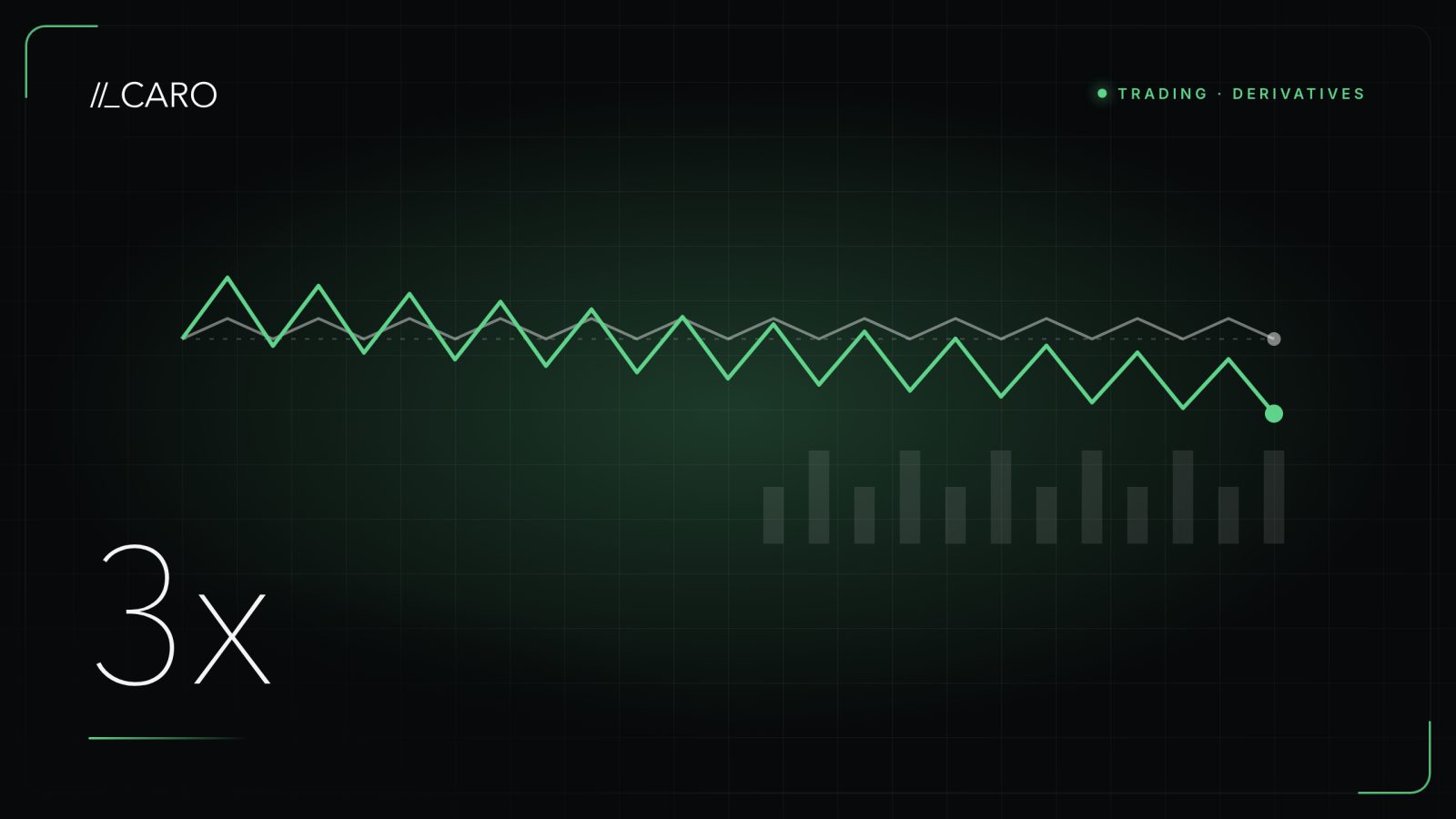
A 3x leveraged fund promises three times the return for one day only. It resets its leverage every day, and the daily returns compound. If the asset rises 10% and falls 10% the next day, it is down 1%, while the fund is down 9%, three times worse than the "triple" result of 3%. On October 2, 2026 the SEC approved the listing of six such funds, including funds on Bitcoin and Ether.
What did the SEC approve on October 2, 2026?
The Commission approved a Cboe BZX Exchange rule change (Release No. 34-106577) that allows the listing of six 3x leveraged Volatility Shares Trust funds: on Bitcoin, Ether, gold, silver, crude oil and natural gas. The exchange filed the proposal on August 10, 2026, Crypto Briefing reports.
The funds get their exposure through futures and do not hold the assets themselves. Each fund targets three times the daily performance of its underlying asset. Approval of the listing rule is not the start of trading: a Form S-1 registration statement has to become effective first, and no date has been given.
How does the daily reset change the result?
To deliver exactly 3x again tomorrow, the fund brings its position back to three times its net assets at the end of each day. After an up day it buys more futures, and after a down day it sells. In a choppy market that means buying high and selling low.
A two day calculation, without fees:
| Day | Asset | 3x fund |
|---|---|---|
| 1 | +10% | +30% |
| 2 | -10% | -30% |
| Total | -1% | -9% |
Asset: 1.10 × 0.90 = 0.99. Fund: 1.30 × 0.70 = 0.91. Repeat that pair of days ten times and the asset is down about 9.6%, while the fund is down about 61%.
Does the price path always work against the holder?
No. In a one-way move compounding helps. Two consecutive days of +10% give the asset 21% (1.10 × 1.10) and the fund 69% (1.30 × 1.30), against a "triple" 63%. Compounding losses grow with price swings and with the length of the holding period. The same monthly result for the asset can therefore match very different results for the fund.
What happens in a one third drop within a single day?
The arithmetic of 3x leverage is this: a 33.34% fall in the asset in one day means a 100% loss for the fund. There is no recovery after that, even if the asset returns to its previous price the next day, because nothing is left to compound. The holder faces no margin calls and no liquidation in the exchange sense, and the loss is capped at the amount invested.
What limits and risks should be kept in mind?
- The examples are arithmetic. They leave out the fund's fee, futures roll costs and tracking error. Crypto Briefing notes separately that rolling contracts affects long term performance.
- The fund holds futures. Its price can diverge from the spot price of Bitcoin or Ether.
- Listing approval assesses compliance with exchange rules and says nothing about who the product suits.
- The fund's target is set for one day. The longer the holding period, the more the result depends on the price path.
- Trading has not started, and the terms of individual funds may change before the Form S-1 becomes effective.
Sources
- Crypto Briefing. SEC approves 3x leveraged Bitcoin and Ether ETPs, but trading has to wait — https://cryptobriefing.com/sec-approves-3x-leveraged-bitcoin-ether-etps/
This article is for information only and is not individual investment advice. Trading crypto carries the risk of losing your funds; results on historical data do not guarantee future results.
Check the strategy against your own data
ACARO is a terminal that executes a strategy on your own exchange account. Parameter search and backtesting on history are part of the subscription.
See pricing