
What Is a Tokenized Option, and Why Is It Harder to Issue Than a Tokenized Stock?
Cboe and S&P Dow Jones Indices extended the S&P 500 index options license through 2051 and left room for work on tokenized options. Here is how an option differs from a stock as something to tokenize, and which questions remain open.
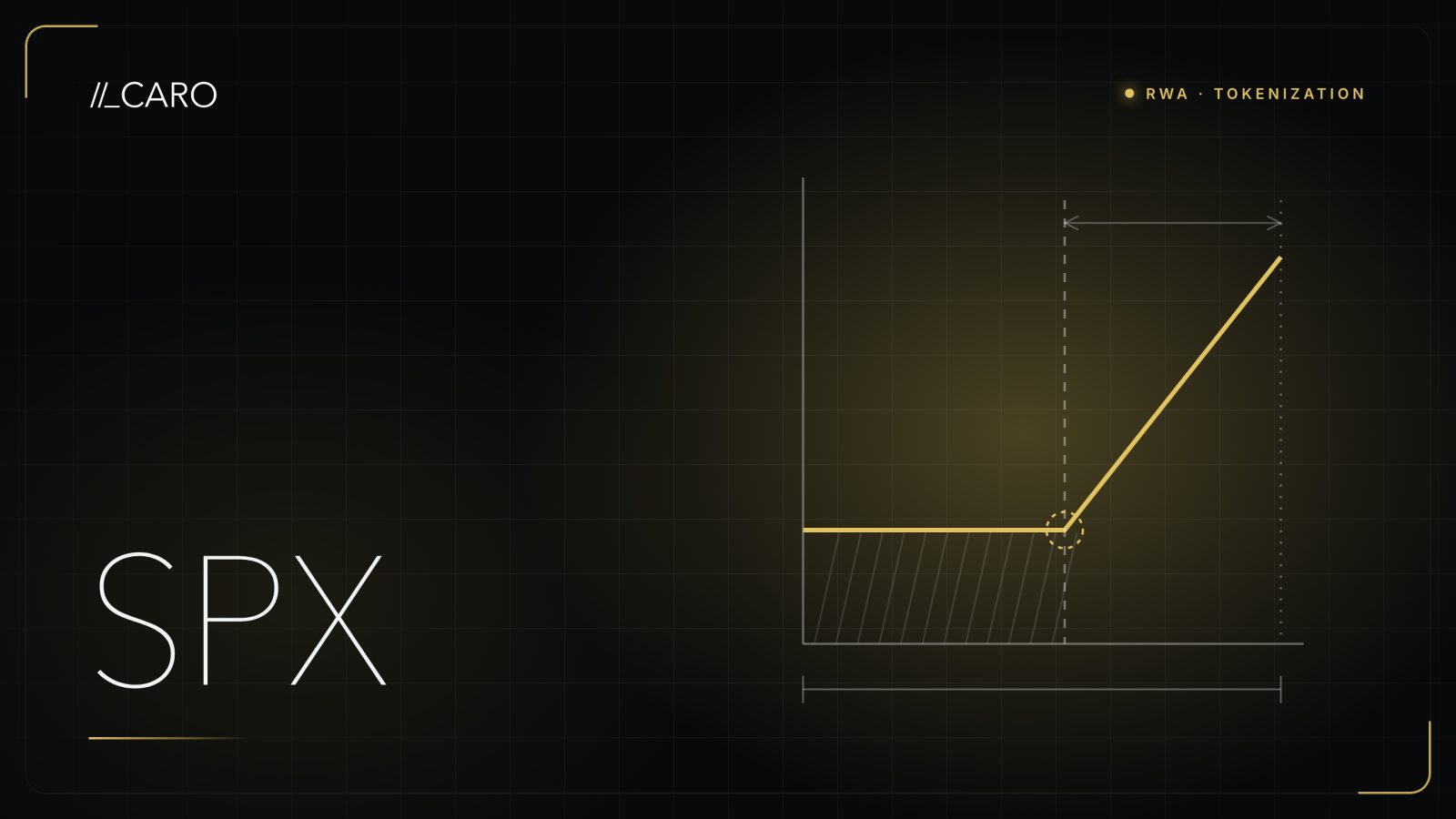
A tokenized option is a blockchain record that gives its holder the rights under an option contract: to buy or sell an asset at a set price by a set date, or to receive a cash settlement. It is harder to issue than a stock token because an option exists as a two-sided obligation with a term, a strike and the seller's collateral. No major US exchange offers such a product yet.
What did Cboe and S&P Dow Jones Indices announce?
On September 29, 2026, Cboe Global Markets said it had extended its exclusive licensing agreement with S&P Dow Jones Indices by 25 years, through 2051. The exchange keeps the exclusive right to offer trading in S&P 500 Index (SPX) options. Royalty terms for 2026 do not change, and new terms start in 2027.
According to CoinDesk, the two firms may also collaborate on products beyond traditional index derivatives, including tokenized options contracts. They disclosed no specific product and no launch date. Decrypt gives the scale of the existing market: 970.6 million SPX contracts in 2025, a record for the instrument. The partnership began in 1983 with the launch of SPX options.
How does an option differ from a stock as something to tokenize?
A share already exists: a company issued it, and it sits in a register. A stock token mirrors the right to that share or the ownership record itself. The number of tokens is capped by the number of shares behind them.
An option appears at the moment of a trade. The buyer pays a premium, the seller takes on an obligation, and a new contract is created from nothing. The count of open contracts grows and shrinks every day. Each contract has a strike and an expiry date, and after that date the contract no longer exists.
That creates three tasks a stock token does not have:
- securing the seller's obligation: someone has to hold the seller's collateral and recalculate the requirement as the price moves;
- handling expiry: on the set day the contract has to be settled and the token retired;
- tracking series: options on the same index with different strikes and dates are not interchangeable, and each series needs its own liquidity.
Why do options need a clearing house?
In the US listed market, options are issued and guaranteed by the clearing organisation OCC. It becomes the counterparty to every buyer and every seller and collects collateral from sellers. Because of that, a buyer does not have to assess whether a particular seller can pay.
A tokenized option has to either plug into that system or replace it with its own. In the first case the token is a new way to record rights under a contract that the clearing house still guarantees. In the second, the guarantor's role passes to a smart contract holding collateral, and the payout then depends on the code, the price oracle and whether the collateral is sufficient. Cboe and S&P have not said which path they are considering.
How does this relate to the rules for tokenized stocks?
On September 17, 2026, the SEC issued a five-year exemption that lets certain US venues trade tokenized versions of listed stocks without registering as exchanges, The Block reports. The exemption caps the number of symbols and the trading volume, and requires that a token carry the same rights as the share. Decrypt ties the interest in tokenized options to that decision, but the decision describes stocks. The sources for this article contain no rules written specifically for tokenized options.
What limits and risks should you keep in mind?
- The announcement states an intention. There is no product, specification or timeline, and none may follow.
- An option is an instrument with a term. A purchased option can expire worthless, and the buyer loses the entire premium. The seller of an uncovered option risks an amount larger than the premium received.
- A token does not remove counterparty risk by itself. That risk depends on who guarantees performance: a clearing house or a smart contract with collateral.
- Trading a token around the clock while the underlying market is closed creates price gaps, especially for an index calculated from securities with exchange hours.
- This article relies on a press release and media reports dated September 29 and October 2, 2026. The legal structure of any future product is unknown.
Sources
- Cboe Global Markets — пресс-релиз о продлении лицензии с S&P Dow Jones Indices (SEC EDGAR, Ex. 99.1) — https://www.sec.gov/Archives/edgar/data/0001374310/000110465926111989/tm2626203d1_ex99-1.htm
- CoinDesk — Cboe, S&P Dow Jones open door for tokenized options under extended licensing deal — https://www.coindesk.com/business/2026/09/29/cboe-s-and-p-dow-jones-may-explore-tokenized-options-contracts-under-extended-licensing-deal
- Decrypt — Cboe's S&P deal and tokenized options — https://decrypt.co/379619/cboes-sp-deal-tokenized-options
- The Block — SEC's innovation exemption and Robinhood — https://www.theblock.co/news/regulation/2026-10-02-secs-innovation-exemption-robinhood-417538
- OCC — What Is OCC — https://www.theocc.com/company-information/what-is-occ
This article is for information only and is not individual investment advice. Trading crypto carries the risk of losing your funds; results on historical data do not guarantee future results.
Check the strategy against your own data
ACARO is a terminal that executes a strategy on your own exchange account. Parameter search and backtesting on history are part of the subscription.
See pricing