
What Happens to a Tokenized Stock in a Split, and Why Does Your Balance Change Without Your Signature?
In a stock split, tokens are not reissued: the issuer changes one multiplier in the contract and wallets show twice as many shares. We look at ERC-8056, the new issuer functions in Base's Cobalt upgrade, and the pricing errors this creates.
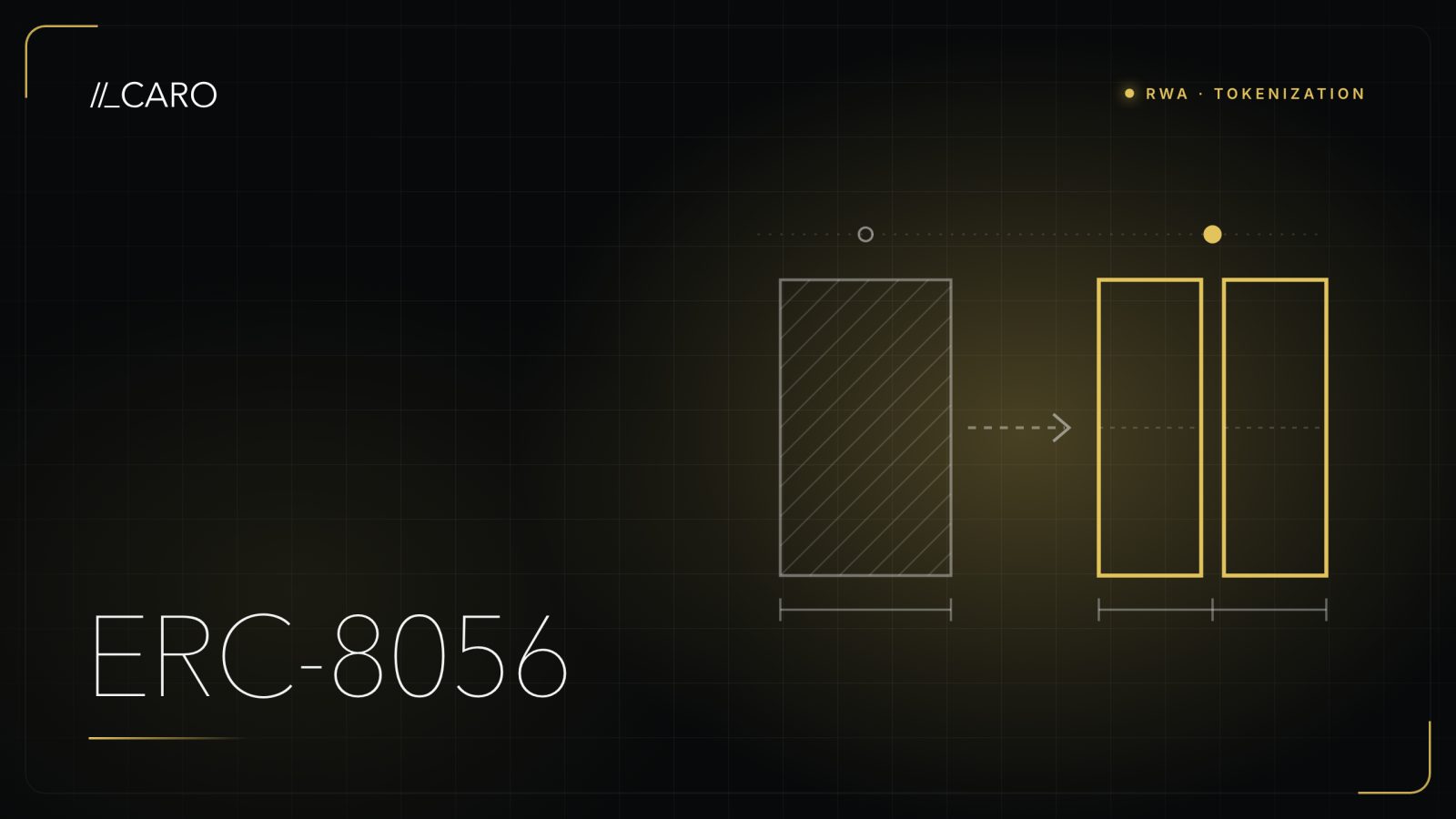
When a tokenized stock splits, the issuer does not mint new tokens or send them to holders. It changes a single multiplier in the contract, which wallets and exchanges apply to the recorded balance. The share count on screen doubles, the price per share halves, and the position's value stays the same. No holder signature is needed: the right to change the multiplier is built into the contract and belongs to the issuer.
Why can't a split be done as an ordinary token distribution?
For a conventional stock in a 2-for-1 split, the broker simply updates its records. On a blockchain, new tokens would have to be minted to every address. That is costly and, more importantly, breaks accounting inside protocols: a liquidity pool or lending contract holding the tokens does not expect its balance to change on its own.
ERC-8056, proposed in October 2025 and still in draft status, solves this with a "scaled UI amount." The contract exposes uiMultiplier(), an 18-decimal number. A value of 1e18 is a 1.0 multiplier; 2e18 is a 2.0 multiplier, as in a 2-for-1 split. Recorded (raw) balances and total supply do not change; the share count is derived by multiplication.
What does this look like in practice?
A write-up by SQD documents a real case. On Friday, June 26, 2026 at 20:50 UTC the WEEK token contract on Robinhood Chain announced that its multiplier would change from 1.003091 to 2.006183. The change took effect on Monday, June 29 at 13:30 UTC, at the New York market open — about 65 hours after the announcement.
An address with a raw balance of 0.7404 WEEK holds 1.4854 units at a 2.0062 multiplier. The on-chain record did not change — the way it is read did.
What did Base's Cobalt upgrade add?
On September 30, 2026 at 18:00 UTC Base activated its Cobalt upgrade. As crypto.news describes it, the B20 token standard gained three optional functions for issuers:
- scheduled multiplier updates: a future change such as a split is announced in advance and takes effect at a set time without holder signatures;
seizeWithMemo— an issuer-authorized transfer of a holder's balance with an explanatory memo recorded on-chain; it replaces the earlier mechanism of burning blocked tokens;- composite policies: several allowlists and blocklists combined with "or" or "and" logic.
The outlet stresses that the network supplies the tools, while the issuer decides how they are governed. We covered allowlists in detail in our article on transfer restrictions for tokenized securities, and payouts in the piece on coupons and corporate actions.
Where do pricing errors come from?
The main trap is confusing raw tokens with shares. After a 2-for-1 split the exchange price of one share halves, but one raw token now represents two shares, so its value is unchanged.
- If a service divides the trade amount by raw tokens and compares the result with the stock's exchange price, it will see a false twofold discrepancy.
- An indexer that reads only raw balances understates every WEEK position by half at a multiplier near 2.006, by SQD's estimate.
- The ERC-8056 specification states explicitly that protocols must track raw amounts internally and that pricing systems must use one consistent representation; otherwise the mismatch can be arbitraged.
What limits and risks should be kept in mind?
- ERC-8056 is a draft. Not every wallet or service supports it, and the same balance can be displayed differently in different places.
- The multiplier is changed by whoever holds admin rights. The specification lists unauthorized multiplier changes as a risk: they mislead holders about the size of their position.
- A seize function means a token at your address can be moved without your involvement — under a court order, a regulator's demand or the issuer's rules. The conditions are set out in offering documents, not in code.
- The functions are optional. Their presence in a standard does not mean a particular issuer has enabled them; that has to be checked token by token.
- Technical features do not define rights to the underlying asset: dividends, voting and claims in insolvency depend on the legal structure of the issue.
Sources
- crypto.news — Base Cobalt upgrade puts new controls inside tokenized assets (01.10.2026) — https://crypto.news/base-cobalt-upgrade-puts-new-controls-inside-tokenized-assets/
- Ethereum Improvement Proposals — ERC-8056: Scaled UI Amount Extension for ERC-20 Tokens — https://eips.ethereum.org/EIPS/eip-8056
- SQD — ERC-8056 Explained: How Tokenized Stocks Split Onchain (02.07.2026) — https://sqd.dev/learn/erc-8056-tokenized-stock-splits/
- Parameter — Base Network Rolls Out Cobalt Upgrade With Conditional Transactions (01.10.2026) — https://parameter.io/base-network-rolls-out-cobalt-upgrade-with-conditional-transactions/
This article is for information only and is not individual investment advice. Trading crypto carries the risk of losing your funds; results on historical data do not guarantee future results.
Check the strategy against your own data
ACARO is a terminal that executes a strategy on your own exchange account. Parameter search and backtesting on history are part of the subscription.
See pricing