
What Is Stablecoin Multi-Issuance, and Why Do European Regulators Want to Ban It?
Two companies issue the same stablecoin: one licensed in the EU, the other outside it. Circle is asking the European Commission to keep this model, while the ESRB and the ECB propose banning it. Here is how multi-issuance works and what the dispute is about.
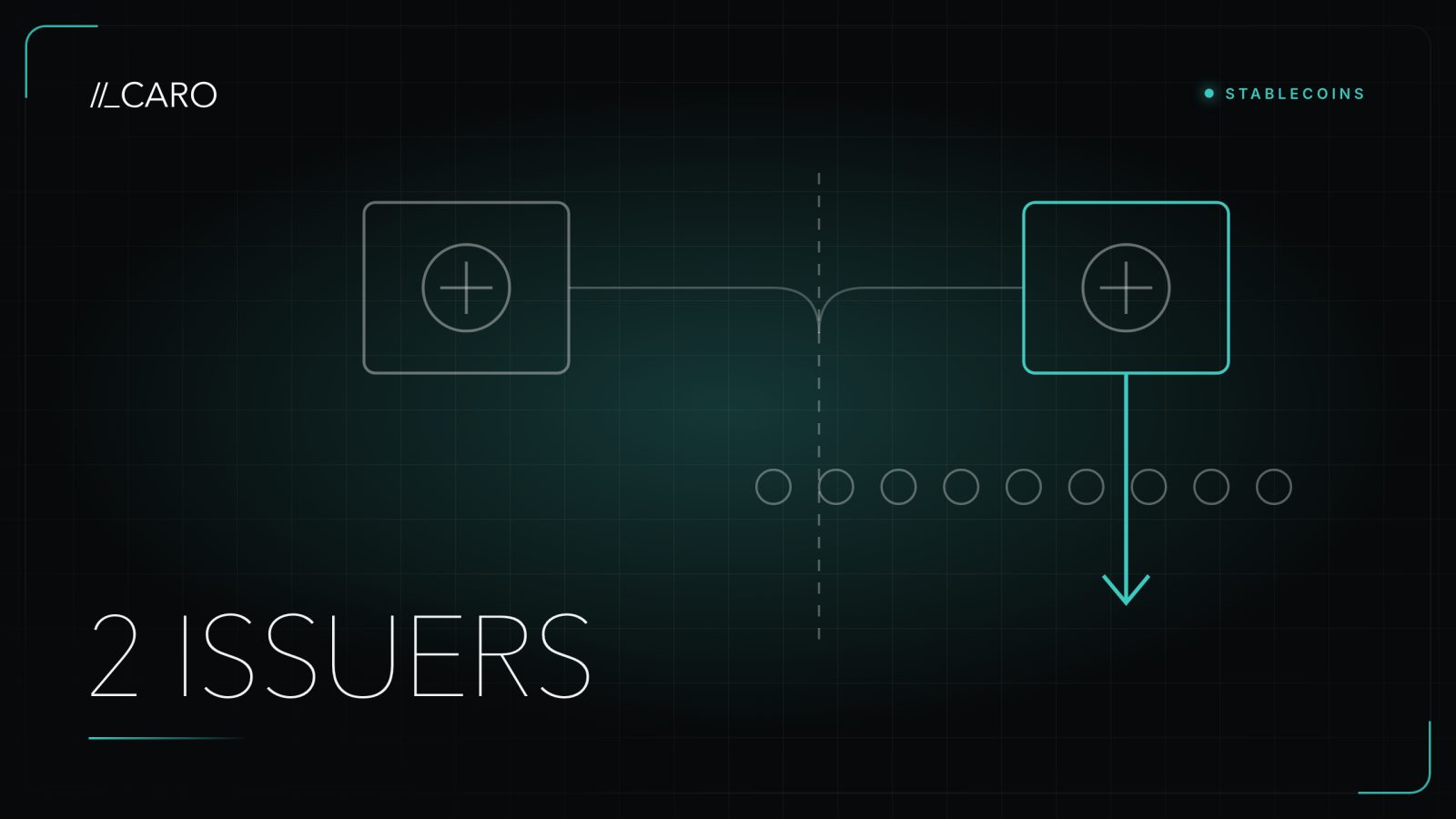
Multi-issuance is a setup in which two companies of one group issue the same stablecoin: one is authorised in the EU under MiCA, the other operates under a third country's rules. The tokens are indistinguishable, while the reserves are split between jurisdictions. European regulators worry that under stress redemptions would concentrate on the EU issuer and its share of the reserves would fall short.
How does multi-issuance work?
Cointelegraph describes the model this way: an EU-authorised entity and a foreign-regulated counterpart co-issue one stablecoin. The ESRB adds that the EU entity is typically owned or controlled by the non-EU one, and that reserves are distributed across the two jurisdictions.
For the user there is one token. Nothing on the blockchain marks which issuer minted a given coin, and coins move freely between wallets worldwide.
Why do the ESRB and the ECB see a risk here?
The European Systemic Risk Board named two problems in Recommendation ESRB/2025/9, adopted on September 25, 2025. First, in a run holders could turn to the EU issuer for redemption, which would strain its reserves and delay payouts. Second, third-country authorities could restrict the transfer of reserves between jurisdictions during stress.
The ESRB also noted that MiCA does not explicitly envisage joint issuance by EU and third-country entities and so cannot address the related risks. It recommended that the European Commission clarify by the end of 2025 that the regulation does not permit such schemes. In case no clarification came, it proposed a set of safeguards with deadlines at the end of 2026 and 2027.
The question moved into the scheduled MiCA review. In the European System of Central Banks' response to the Commission's consultation, the ECB, as summarised by Freshfields, endorsed the ESRB recommendation in full, "including preferably a prohibition" of such schemes. The European Banking Authority rated existing safeguards as only "slightly effective" once the main functions sit outside the EU.
What does Circle say in response?
On October 2, 2026, Circle sent the Commission its own response to the same consultation. The company asks to preserve multi-issuance and warns that restricting it would push users toward offshore issuers outside MiCA's protections. By Circle's count, three of the 25 largest stablecoins by market value are MiCA-regulated.
In the same document Circle asks to replace the mandatory share of reserves in bank deposits (30%, or 60% for significant issuers) with liquidity requirements. A separate article covers that rule: "Why Does MiCA Make Stablecoin Issuers Keep Reserves in Banks, and Why Does the ECB Want to Scrap It?".
What does this change for a stablecoin holder?
Until the rules change, nothing changes for a holder: there is one token and it trades on the same venues. The dispute is about what happens in a mass redemption. Supporters of the model point to unified liquidity and a globally fungible token. Opponents point out that the EU share of the reserves is sized for the EU share of issuance, while claims on it can come from holders anywhere.
The Commission's decision will determine whether global issuers can keep serving EU clients with the same token they use elsewhere, or will need a separate European issue.
What limits and risks should you keep in mind?
- Nothing is decided yet. The ESRB, ECB and Circle positions are recommendations and consultation responses with no binding force.
- EU national regulators disagree on whether the model is allowed today. Until a clarification arrives, its legal status is contested.
- One-to-one redemption is a right against a specific issuer on that issuer's terms. Holding the token in a wallet does not mean direct access to redemption at either of the two companies.
- The "three of 25" figure comes from Circle, a party to the dispute, and was not independently checked for this article.
- A stablecoin can move off its peg when the issuer or a bank holding its reserves is under stress. Regulation lowers that risk and does not remove it.
Sources
- Cointelegraph — Circle Seeks Changes to EU Stablecoin Reserve Rules — https://cointelegraph.com/news/circle-eu-stablecoin-reserve-rules-mica-review
- ESRB — пресс-релиз о рекомендации по third-country multi-issuer schemes, 20.10.2025 — https://www.esrb.europa.eu/news/pr/date/2025/html/esrb.pr251020~84e90ccc73.en.html
- ESRB — Recommendation ESRB/2025/9 — https://www.esrb.europa.eu/pub/pdf/recommendations/esrb.recommendation251020.en.pdf
- ESCB — response to the European Commission's consultation on the MiCAR review — https://www.ecb.europa.eu/press/consultationresponse/pdf/ecb.conresp202609_micarreview.en.pdf
- Freshfields — MiCA Under the Microscope: What the EBA and the ECB Told Brussels — https://www.freshfields.com/en/our-thinking/blogs/technology-quotient/mica-under-the-microscope-what-the-eba-and-the-ecb-told-brussels-about-the-revie-102o3sd
This article is for information only and is not individual investment advice. Trading crypto carries the risk of losing your funds; results on historical data do not guarantee future results.
Check the strategy against your own data
ACARO is a terminal that executes a strategy on your own exchange account. Parameter search and backtesting on history are part of the subscription.
See pricing